

Cagliari, Thirty Years Early.
In 1994, Cagliari briefly believed the internet would abolish distance. It was wrong about the direction.
Matteo Cantarelli
Author
In 1993, two colonies established themselves in Cagliari. At a research centre on the city's outskirts, engineers put Italy's first website online. And in the Molentargius wetlands — a stretch of saltwater ponds wedged between the city's apartment blocks and its beach — greater flamingos began nesting for the first time, having apparently decided that this particular capital city suited them.
The engineers were the more improbable arrivals. The following year their centre, CRS4, helped put L'Unione Sarda online — one of the first newspapers in Europe on the web. That same year the paper's owner, Nicola Grauso, launched Video On Line, an internet provider that by 1995 served something like a third of Italy's internet users — from Cagliari. Then, in 1998, came Tiscali, founded in the same city by Renato Soru and briefly worth €18 billion at the turn of the millennium.
The thesis behind all this was simple and intoxicating: the internet would abolish distance, and an island in the middle of the western Mediterranean would stop being peripheral. The thesis was wrong. Or rather, it was early. Telecom Italia absorbed Video On Line in 1996. Tiscali deflated with the rest of the dot-com era. And for the next quarter century, ambitious Sardinians did what ambitious people everywhere did: they moved to where the jobs, capital, and other ambitious people were. Distance did not die; the whole logic of San Francisco, London, and Milan was that proximity compounds.
That logic has not collapsed, and the lazy version of the argument — geography is over, work from anywhere — is contradicted by the data. Remote work surged, then froze: a quarter of American paid working days now happen at home, college-educated workers worldwide average 1.2 remote days a week, and the figures have barely moved since 2023. Meanwhile the AI boom has produced the most aggressive re-concentration of talent in a generation: in 2025, some 60 percent of the world's AI venture funding landed in one metropolitan area, and San Francisco rents rose faster than anywhere in America. The geography of production is very much alive.
What changed is quieter, and more interesting. For a growing minority of professionals, the network itself has come apart from the map. A founder in any European city now spends her day with an engineer in Warsaw, a customer in London, an investor who moved to Miami. The offlce returned; geographic coherence did not. For people in that position, where should I live? has come apart from the question that used to answer it: where is my industry? Professional networks, it turns out, can be distributed. A life cannot. Dinners, schools, running partners, the accidental repeated encounters through which a place becomes home — these still require coordinates.
Which is where Cagliari becomes a case study, though not for the reasons its tourist board would choose.
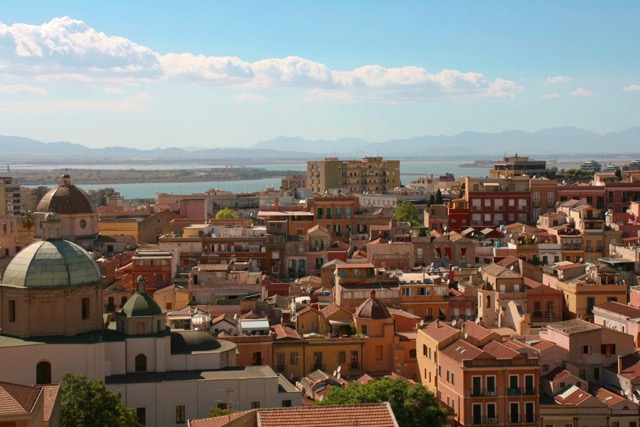
Cagliari is not, in any meaningful sense, a tourist town. Of Sardinia's 18.9 million overnight stays in 2024, the capital accounted for roughly 960,000 — fewer than Alghero. The visitors go north, to the Costa Smeralda, two hundred kilometres away. What remains in Cagliari is a working city of about 150,000 people (420,000 in the metropolitan area): a regional capital with courts, a port, ministries, and a university of 27,000 students. Its bars and restaurants — and there are improbably many, packed into the Marina district's grid of narrow streets — price for locals, because locals are who show up in November.
This matters more than it sounds. The cities that became magnets for internationally mobile professionals over the past decade were mostly optimised for the influx — and paid for it. Lisbon's housing prices roughly doubled between 2015 and 2023; Portugal and then Spain killed their golden visas; tens of thousands marched in Palma and the Canaries against being priced out of their own cities. Cagliari avoided that fate by the simplest mechanism available: nobody optimised it. It was, by the scoreboard of the last forty years — GDP density, corporate presence, connectivity to capital — behind.
But scoreboards change. Measure an ordinary Tuesday in February and the accounting inverts. The Poetto, eight kilometres of sand, begins where the city ends; people swim before work in a month when Milan is fog. The airport is a ten-minute drive from the centre and handled 5.2 million passengers last year. Apartments average around €2,700 per square meter — roughly a quarter of central Milan. The air is clean enough that the city logged zero days over the ozone threshold in Legambiente's latest survey; the sun delivers 2,700 hours a year. Between the offlce and the beach, the commute crosses a flamingo colony.
And for the first time in decades, money and attention are moving toward exactly those assets. The seafront is being stitched together — a rebuilt promenade at the Poetto, a new waterfront walk at Su Siccu, and on it, as of this June, an open-air Teatro del Mare. Via Roma, the city's front porch, has re-emerged from a two-year redesign, completed with authentic municipal drama (one stretch was dug up twice because someone forgot the gas line). A light-metro extension inches toward the centre, promised for December 2026 and believed by approximately no one. Two grand palazzi have reopened as five-star hotels — Palazzo Doglio, then Palazzo Tirso, the electricity company's old marble headquarters — the ruined seafront Ospedale Marino is approved to become a third, and the local press counts eight more in the pipeline. And in May the first preliminary regatta of the 38th America's Cup was sailed in the city's gulf — won, satisfyingly, by Luna Rossa, the challenger based on Cagliari's own docks. None of this is a masterplan; it is a city noticing, at last, which way it faces.
Plenty pulls the other way. Italy is among Europe's least remote-friendly labour markets — under 3 percent of Italian workers "usually" work from home, and the country's digital-nomad visa, launched in 2024, has published no uptake figures, which tells its own story. Sardinia's fertility rate, around 0.9, is the lowest in Italy; on current projections the island loses a third of its population by 2060. Regional GDP per capita sits at 72 percent of the EU average, and the health system is short some 500 doctors. And in January the flight map thins: the island reminds you it is an island. Foreign interest is rising — purchase inquiries up 30 percent in three years, a quarter of them American — but most of it targets second homes in the north. Whatever is happening in Cagliari is small. Beginnings usually are.
The difflculty, though, does quiet work of its own: it filters. Cagliari is not a place to arrive with a CV and hope; the local market cannot hand out careers the way Milan or London can. You bring your work with you, or you come to build something that does not exist yet. People who settle despite the winter flight map and the paperwork tend, in short, to be builders — and to mean it. It is tempting to call them pioneers, though on an island that has been inhabited for six thousand years, the humbler word is early. And an island losing eight thousand residents a year is not a backdrop for anyone's lifestyle experiment — it has a stake in every arrival. The newcomers get the Tuesdays. The island gets back the thing it has spent a century exporting: people.
What does exist, concretely, is something most Mediterranean relocation fantasies lack entirely: infrastructure that predates the trend it might now serve. The Net Value, an incubator run by a former Tiscali manager from a Liberty-era palazzo near the port, is where Moneyfarm — today one of Europe's larger digital wealth managers — was hatched. Open Campus runs a coworking community out of part of Tiscali's old campus on the lagoon. Opificio Innova has installed coworking desks, robotics labs, and a learning centre in the city's former tobacco factory. Sardegna Ricerche, the regional innovation agency, operates a technology park and startup voucher funds; even Regus, purveyor of interchangeable offlces worldwide, keeps two addresses in town. There is something archaeological about all of it — much of this lattice descends, through people or buildings, from the 1990s experiment. The city built for a future that didn't arrive kept the furniture.
And the people now arriving are finding each other with a speed that suggests appetite. Since late 2023, EMC — Entrepreneurs Meet Cagliari — has been holding monthly gatherings of founders, professionals, and investors in wine bars and coworking spaces around the city: a designer next to a researcher next to a chef, none of them each other's industry, all of them each other's neighbourhood. NODI, a network founded in 2021 to connect Sardinians abroad with the island — and, increasingly, newcomers to it — drew nearly 400 participants to Sardinia Unlocked last November, a two-day co-design marathon across fifieen-odd hubs from Cagliari to Olbia, backed by the regional government, around a single question: how does an island plug itself into the world? The professional graph is global; the social graph still needs a place. In Cagliari, the place is being furnished.
Grauso, who died last year, was not wrong in 1994 — only early, and mistaken about the direction. The internet never made Cagliari a centre. Instead, three decades on, it has begun making centrality itself optional, for some people, some of the time. The flamingos understood the proposition first: shallow water, mild winters, few predators, a habitat nobody had gotten around to draining and developing. They came to visit, and then, finding the ordinary Tuesdays agreeable, they stayed and raised their young there. Make of that what you will.